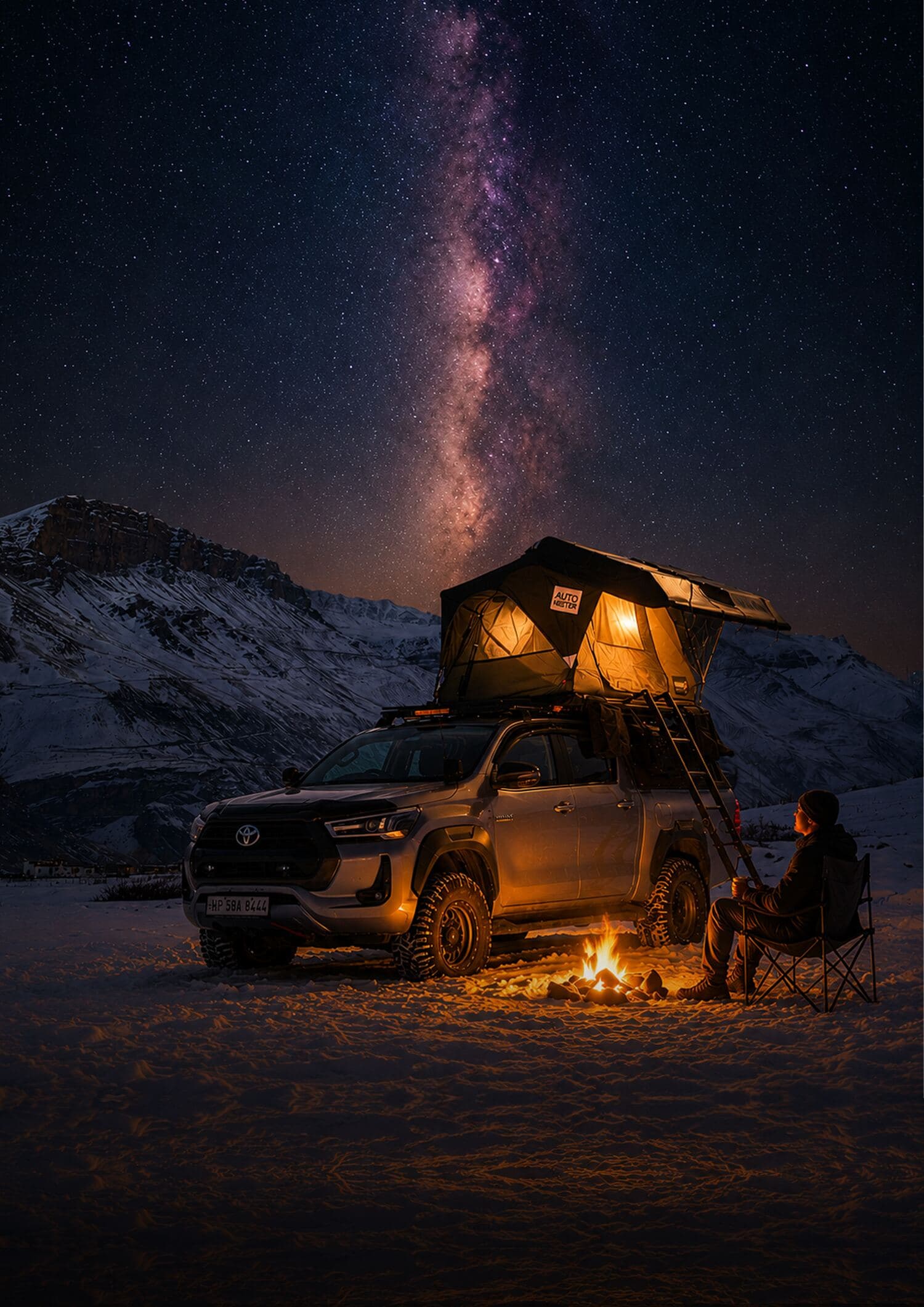
Auxiliary lighting
Best Off Road Lights in India: LED Bars vs Pods, Lumens vs Lux, Wiring & Legality
Best off road lights in India: LED bars vs spot/flood pods, lumens vs lux explained, relay wiring, road legality under CMVR, and mounting for Thar, Hilux & Jimny.
The best off road lights in India are the ones matched to your actual terrain and kept legal on the highway — a single high-output LED bar is rarely the right answer for Himalayan overlanding. For most Thar, Hilux and Jimny owners running Spiti, Ladakh, Sach Pass or the Western Ghats at night, the smart setup is a pair of driving/spot pods for reach plus a flood or a bar for the foreground, wired through a relay and a switch, and switched OFF the moment you hit a public road. This guide walks through pods vs bars, the lumens-versus-lux confusion that sells the wrong light, honest wiring and legality on Indian roads, and mounting that survives corrugations to Pangong.
LED bar vs spot/flood pods: what actually belongs on an Indian overlander
A light bar throws a wide, even wash — brilliant in a campsite, on a slow forest track, or for close-in trail work where you need to see the whole width of the ruts. But a bar's beam usually dumps out around 200–300 m and, on a fast dirt road, it lights the ground three metres ahead more than the corner you are about to arrive at. Spot/driving pods do the opposite: a tight beam that punches 500–800 m down a straight, exactly what you want closing on a Ladakh water crossing at dusk. The experienced answer on Indian terrain is a combo: pods (or a combo bar) for distance, flood for the foreground, wired so you can run them independently. A 20-inch bar over the number plate plus two 3–4 inch pods on the bull-bar tabs covers 90% of real overland driving.
Lumens vs lux: the number that actually matters
This is where buyers get fleeced. Lumens measure total light a lamp produces; lux measures light landing on a surface at a distance. A cheap bar screaming '30,000 lumens' can still leave the road dark at 300 m because it spreads that output everywhere. Reputable makers quote lux at distance — usually the '1 lux' figure, the range at which the beam fades to roughly full-moon brightness. A pod rated 1 lux @ 500 m genuinely reaches 500 m; a bar with a huge lumen figure but a 250 m 1-lux rating does not, no matter what the box says. Buy on lux-at-distance and beam pattern, treat raw lumens as marketing, and be sceptical of any Indian marketplace listing that quotes only lumens and a wattage that is physically impossible for the chip count shown.
- Reach/distance driving (open Ladakh straights, cold-desert): spot/driving beam, judge by 1-lux range in metres, not lumens.
- Foreground/trail (Ghats forest tracks, technical rock): flood or diffused beam, wide spread matters more than reach.
- One-light compromise: a 'combo' bar with spot centre + flood edges — the honest all-rounder for a first build.
- Ignore: 'lumens' as the headline spec, and any listing where wattage and price look too good to be real.
Colour temperature and cold: why 4000–5000K wins in the Himalaya
Ice-white 6000K+ LEDs look aggressive in photos and scatter badly in exactly the conditions you meet above Manali — fog on the Rohtang side, dust plumes behind a convoy to Hanle, and snow glare near Baralacha. A warmer 4000–5000K beam, or a set of selective-yellow pods, cuts through mist and blowing snow far better and is less tiring on a 14-hour transit day. For genuine Himalayan winter and monsoon Ghats work, many overlanders run white spots for reach plus a pair of amber floods they switch to when the weather closes in. Also check the housing: at Spiti and Ladakh overnight lows the cheap potted-LED units crack and let moisture in — look for a genuine IP67/IP69K rating and an aluminium body that sheds heat, because a light that cooks itself in summer Rajasthan fails as surely as one that freezes.
Wiring: relay, fuse, and a proper switch — do it once, do it right
Never run auxiliary lights straight off a switch on thin cabin wiring — the current for a 100–200W bar will melt it. Use a relay so the switch only triggers the relay coil while heavy battery current flows through thick fused cable. A basic, safe loom for one bar plus two pods: 12 AWG (or thicker) from the battery positive through an inline fuse (a 40A blade fuse suits ~120–150W of LEDs) to a 30/40A automotive relay; relay output to the lights; a switched-ignition or dedicated feed to the relay coil via your dash switch; and a clean earth to bare chassis metal, not paint. On a modern Thar Roxx, Hilux or Fortuner, tap an ignition-switched source so the lights cannot be left on to flatten the battery, and keep the pods and bar on separate switches so you can run just the spots on the highway sections where a full wall of light would be dangerous and illegal. If you are not confident with a crimp tool and a test light, pay an auto-electrician — a bad earth or an unfused live is how vehicles catch fire on a remote track.
- Fuse close to the battery — protects the whole run if the cable chafes through on a corrugated road.
- Relay so switch current stays tiny; thick fused cable carries the load.
- Earth to clean bare chassis metal, sealed against water — a poor earth causes flicker and failures at altitude.
- Separate switches for bar vs pods, so you can stay road-legal without rewiring.
- Weatherproof Deutsch-style connectors and split-loom conduit — dust and river crossings destroy cheap bullet connectors.
Legality on Indian roads: the part most sellers won't tell you
Auxiliary off-road lights are, as the name says, for off the road. Under the Motor Vehicles Act and CMVR, only approved headlamps and fog lamps of specified type and mounting are legal for use on public roads; a roof or bull-bar bar blazing on a highway can draw a challan, and forward-facing coloured or excessively bright aux lights are routinely pulled up. The practical, honest rule Indian overlanders follow: fit the lights, wire them on their own switch, and keep them OFF on public roads and in traffic — use them only on trails, private land, and genuine off-road sections. Aiming matters too: point pods down and forward so they light the track, not oncoming drivers. Treat 'DOT/E-marked' claims on marketplace listings with caution; the marking rarely means the light is legal for road use in India. If you want something you can legally leave on, that is a compliant auxiliary fog lamp, not a spot bar.
Mounting: make it survive the road to Pangong
The failure you will actually have is not the LED dying — it is the bracket cracking or the bolt backing out on 200 km of washboard. Number-plate and lower-bumper mounts keep weight low and the beam clear of your own bonnet glare, which a roof-mounted bar throws straight back at you in dust and fog. If you do roof-mount for camp flood, expect glare and wind noise, and use a rack rated for it. Whatever the position: stainless fasteners with thread-lock and nyloc nuts, a rubber-isolated or gusseted bracket to damp vibration, and a strain-relief loop in the cable so corrugations don't saw through the insulation at the connector. Check torque after your first hard day out — Sach Pass and the Hanle washboard will find every loose bolt on the vehicle.
A sensible first setup for Thar / Hilux / Jimny owners
If you are building your first night-capable overlander, resist the urge to bolt on the biggest bar you can find. Start with two quality 4-inch combo or spot pods on the bull-bar or bumper tabs for reach, add a single well-made 20-inch combo bar for foreground and camp, wire everything through a relay and fuse on two separate switches, keep the colour around 4500K (plus amber for weather if you frequent the Ghats or high passes), and aim it all properly. That covers Spiti transit driving, a Ladakh water crossing at dusk, and a Ghats forest track — for a fraction of the price and heat of an oversized single bar, and without the glare that makes big cheap bars miserable to actually drive behind. Budget for a genuinely weatherproof unit over a marketplace bargain; the cheap one fails at the worst possible place, 300 km from the nearest auto-electrician.
Where AdventureX fits — honestly
Full disclosure: AdventureX 4x4 does not make auxiliary lights yet. We are a Faridabad-based overland-gear brand expanding our range, and lighting is on our roadmap — we would rather tell you that straight than sell you a rebadged marketplace bar. If you would like us to notify you when our lighting range is ready, register your interest at /contact and we will reach out — no spam, no fake launch date. In the meantime, the gear we do build supports the same night-and-remote missions this guide is written for: our recovery gear (traction boards, kinetic ropes, shackles and the X-Flate air compressor) for when a water crossing goes wrong after dark, our Hydrox aluminium water tanks and ThermaEvo diesel heaters for cold-desert camps, and our AutoNest and Bison61 rooftop tents plus the SaberLight 270° awning for the campsite your new flood light will illuminate. Build the night-driving setup right, keep it legal, and come to us for everything around it.
Ready to kit out?
Everything in this guide is built, stocked and backed by AdventureX4x4 — engineered for Indian cold and proven from Spiti to Ladakh.