Suspension
Lift Kit for 4x4 India: Spacers vs Full Kits, Ride Height, Load & Legality
A real India buyer's guide to choosing a lift kit for 4x4: spacers vs full kits, ride height, load, articulation, Thar Roxx & Hilux specifics, warranty and RTO legality.
Choosing a lift kit for 4x4 India comes down to one honest question: how much lift do you actually need, and are you willing to pay for the geometry, alignment and warranty consequences that come with it? For most Thar, Thar Roxx, Gurkha, Hilux and Fortuner owners doing Spiti, Ladakh, the Northeast or weekend trails, a 1 to 2 inch (25 to 50 mm) lift is the sweet spot. It clears bigger tyres and rough tracks without wrecking ride quality, CV angles or your factory warranty. Anything taller is a committed build, not a bolt-on. This guide walks through spacers versus full kits, what ride height really buys you, load and articulation trade-offs, and the specifics for the Thar Roxx and the Hilux in Indian conditions.
Spacers vs full lift kits: what you're really buying
A spacer (or leveling) kit is the cheapest way up. Strut-top spacers, coil spacers or torsion-bar keys add roughly 20 to 40 mm of height using your existing springs and dampers. On a Thar or Fortuner front end, a 25 to 30 mm spacer levels the nose against the rear and clears a 32 to 33 inch tyre. Cost is low, fitment is a Sunday-afternoon job, and it's genuinely popular in Delhi-NCR and Bengaluru workshops. The catch: spacers change ride height without changing spring rate or damper valving. You lift the body but keep the same droop, so you gain no real articulation, and you steepen your CV and control-arm angles, which accelerates wear.
A full lift kit replaces the springs and dampers (and on serious kits, adds longer control arms, extended brake lines, diff drop brackets and adjustable panhard/track bars). It is 3 to 8 times the price of a spacer, but it lifts the vehicle the right way: taller, correctly-rated springs plus dampers valved for the new travel. That means you keep or improve ride comfort, gain usable wheel travel, and correct the geometry a spacer alone throws out. For anyone loading the vehicle for overlanding — rooftop tent, water, recovery gear, a second spare — a full progressive-rate kit is the honest answer, because it accounts for the extra weight instead of just jacking up a soft factory spring.
Ride height: how much lift, and what it costs you
Ground clearance is seductive but it is not free. Every inch of lift raises your centre of gravity — a real concern on the tall, narrow Thar and Gurkha, which already roll more than a wide Hilux. As a rule of thumb for India: 1 inch (25 mm) is invisible to the law and to most warranties, clears one tyre size up, and needs little more than an alignment. 2 inches (50 mm) is the practical overlanding maximum for a daily-driven vehicle — you'll usually want extended bump stops, possibly a front diff-drop on IFS vehicles (Hilux, Fortuner) to tame CV angles, and a proper wheel alignment afterward. 3 inches and beyond means driveline vibrations, steering correction (adjustable panhard rod on the solid-axle Thar/Gurkha rear), longer brake lines, and often a re-geared speedometer once you fit 33s or 35s. That is a garage-built rig, not a weekend upgrade.
Match the tyre to the lift, not the other way round. A 2 inch lift on a Thar comfortably runs a 255/75 R16 or a 33x10.5 without major cutting; a Hilux on a 2 inch lift handles a 265/70 R17 easily. Going bigger for looks, then lifting to fit, is how people end up with rubbing, blown CVs and a vehicle that understeers on wet Ghat sections.
Load and articulation: the overlanding maths people skip
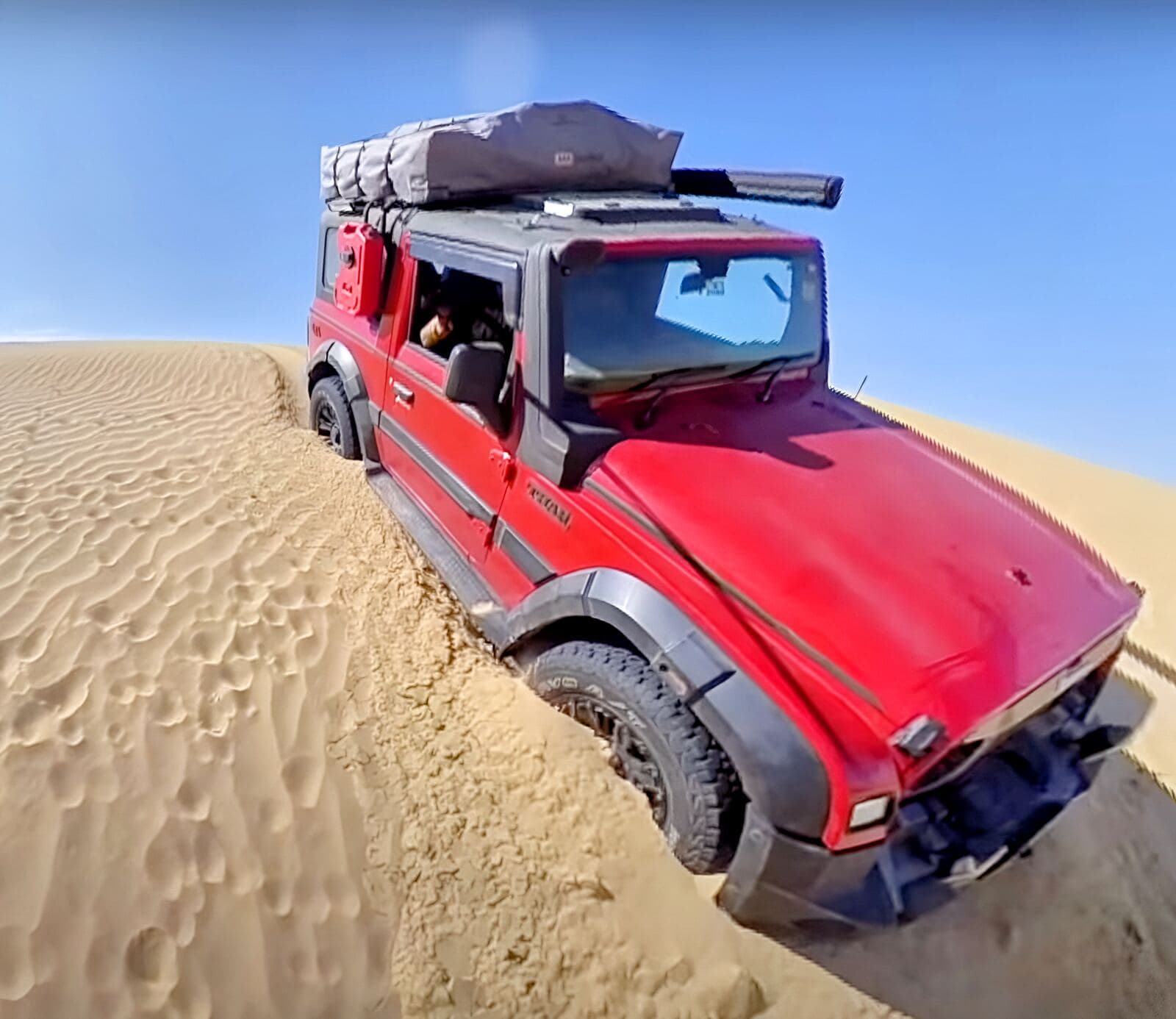
This is where Indian overlanders get caught out. A rooftop tent (35 to 70 kg mounted high), an aluminium water tank, a fridge, recovery boards, a full tank of diesel and two passengers can add 250 to 400 kg — and a lot of it sits high and rearward. Factory springs sag under this, killing the ground clearance you paid for and bottoming the suspension on Spiti's washboard. If you overland, spec a constant-load or progressive-rate spring rated for your typical payload, not a soft 'comfort' coil. Rear helper springs or airbag assisters are common on heavily-loaded Hilux and Isuzu V-Cross builds hauling a canopy and kit.
Articulation — how far one wheel droops while another stuffs — is what keeps tyres on the ground on rutted Himalayan tracks, and it comes from spring and shock travel, not ride height. A spacer gives you zero extra articulation. A full kit with longer-travel shocks and correctly-rated springs gives you flex, which on a slow rock or ruined-road crawl matters far more than an extra inch of static clearance. If your driving is Spiti/Ladakh trails and river crossings rather than tarmac posing, prioritise travel and damping quality over sheer lift height.
Thar & Thar Roxx specifics
The three-door Thar and the five-door Thar Roxx share coil-sprung live axles front and rear (with the Roxx's longer wheelbase making it noticeably more stable lifted). Because both are coil-over-solid-axle, they lift cleanly with coil spacers for a quick 25 to 30 mm, or with full replacement coils plus longer shocks for a proper 2 inch setup. The Roxx's extra length and weight mean it settles a soft spacer lift faster under load — a rated coil is the better buy if you're building it for expeditions. On any lifted Thar, budget for an adjustable rear panhard/track bar to re-centre the axle, and get a four-wheel alignment. The Roxx's electronics (and heavier kerb weight) make ride-quality-matched damping worth the spend; a cheap spacer on soft OE shocks will float and pitch on high-altitude corrugations.
Hilux (and Fortuner) specifics
The Toyota Hilux and Fortuner use independent front suspension (IFS) with coil-over struts up front and leaf springs (Hilux) or coils (Fortuner) at the rear. IFS changes the rules: a front lift steepens CV-joint angles, so at 2 inches many builders fit a front diff-drop kit to bring the angles back toward stock and protect the CVs — critical if you're doing long high-altitude days fully loaded. The Hilux's leaf rear takes load beautifully (it's why it's the overlanding default), and a lift there is a taller leaf pack or an add-a-leaf plus longer shocks rather than a coil swap. For a canopy-loaded Hilux carrying kit, a load-rated rear pack keeps it level; pair it with a front strut lift matched in height so the stance stays even. Extended brake lines and a speedo recalibration become relevant once you're past 2 inches and on 33s.
Warranty and legality in India
Two things every Indian buyer must weigh. First, warranty: OEMs including Mahindra and Toyota can decline claims on components affected by non-OEM suspension modifications — a lifted vehicle that throws a CV, wheel bearing or steering component may not be covered. A mild spacer or a reputable full kit fitted correctly rarely causes issues in practice, but understand you are trading some warranty protection for capability. Fit within the first years of ownership at your own risk, and keep the stock parts. Second, legality: under the Motor Vehicles Act and the 2019 Supreme Court ruling (and subsequent RTO practice), modifications that alter the vehicle from its manufacturer specification can be treated as illegal without endorsement. In reality, a modest 1 to 2 inch lift with correctly-sized tyres is widely tolerated and rarely challenged, but large lifts, oversized tyres poking beyond the body, and altered dimensions can attract RTO attention and insurance complications. Declare significant modifications to your insurer — an undeclared lift can void a claim after an accident.
A practical buying checklist
- Daily-driven, mild trails, one tyre size up: a quality 25 to 30 mm spacer/leveling kit plus alignment.
- Loaded overlanding (rooftop tent, water, recovery gear): a full 2 inch progressive/load-rated kit with matched shocks — not a spacer.
- IFS vehicles (Hilux, Fortuner) at 2 inches: add a front diff-drop to protect CV angles.
- Solid-axle vehicles (Thar, Thar Roxx, Gurkha): add an adjustable panhard/track bar and re-centre the axle.
- Always: four-wheel alignment after the lift, extended bump stops if past 30 mm, and a check on brake-line length past 2 inches.
- Buy for travel and damping quality, not just static height — articulation keeps you moving on Himalayan ruts.
- Keep your stock parts, and declare the modification to your insurer.
Where AdventureX fits in
Straight answer: AdventureX 4x4 does not currently make suspension or lift kits. We're a Faridabad-based overland brand expanding our range, and suspension is on our roadmap — not launched, no date to promise you. If you'd like us to notify you when we do, register your interest at /contact and we'll keep you posted honestly. In the meantime, the gear that actually makes a lifted, loaded rig usable in the field is what we build today: recovery equipment (traction boards, kinetic ropes, shackles, the X-Flate air compressor to air down for articulation and back up after), rooftop tents that turn that new clearance into a proper camp, water tanks, awnings and cold-weather kit for Spiti and Ladakh. A lift gets you up the trail; the right recovery and camp gear gets you home. Browse those, and tell us what you want us to build next.
Ready to kit out?
Everything in this guide is built, stocked and backed by AdventureX4x4 — engineered for Indian cold and proven from Spiti to Ladakh.