Before you buy
The Right Rooftop Tent for a Suzuki Jimny: Weight, Roof Load, and the Lightweight Softshell Answer
A rooftop tent for Jimny must respect a tiny roof and a low dynamic load. Why the lightweight 36.5 kg FeatherLite softshell fits, plus crossbars and cold-camp limits.
If you want a rooftop tent for a Suzuki Jimny, the single fact that decides everything is weight. The Jimny is the most capable small 4x4 in India, but it has a short, narrow roof and a low sensible load limit, so most rooftop tents on the market - 60 to 70 kg hardshells built for a Thar or a Fortuner - are simply too heavy to bolt to it safely. The honest answer for the Jimny is a genuinely lightweight softshell. Our FeatherLite weighs 36.5 kg for the tent (plus 6 kg for the telescopic ladder), which is roughly half what a typical hardshell weighs, and we designed and field-tested it precisely because Jimny owners kept calling us and deserved a real answer. This guide, written from real Himalayan kilometres rather than a spec sheet, shows you exactly how to put a rooftop tent on a Jimny without overloading the one rig that punishes overloading the most.
Start Here: Why the Jimny Is Different From a Thar
Every rooftop-tent buying guide tells you to check your dynamic roof load, and that is true for any vehicle. But the Jimny turns that advice from a footnote into the whole story. A Mahindra Thar has a longer, wider roof and can carry a 60-plus kilogram hardshell comfortably. The three-door Jimny does not have that headroom. Its roof is small, its kerb weight is low at around 1,200 kg, and its centre of gravity is already high for its track width - which is part of what makes it so nimble on a trail and so sensitive to weight up top. Put a heavy tent on a Jimny and you do not just risk the roof structure; you change how the whole vehicle behaves in a crosswind on the Manali bypass and on off-camber Himalayan tracks.
This is why we treat the Jimny as its own category, not a smaller Thar. The compatibility math is unforgiving: there is far less margin between a sensible tent and an unsafe one. Get the weight right and a Jimny becomes a brilliant, self-contained micro-overlander that goes places bigger rigs cannot. Get it wrong and you have built a top-heavy liability that drives worse, brakes worse, and stresses a roof that was never meant to carry a hardshell. So before you look at a single tent, internalise this: on a Jimny, every kilogram on the roof counts double.
The Number That Governs It All: Static vs Dynamic Roof Load
Here is the fact marketplace listings will never spell out. Your Jimny's roof has two completely different load ratings, and confusing them is the most expensive mistake a new overlander makes. The STATIC load is what the roof holds when the vehicle is parked - it is a large number, often 150 to 200 kg or more, and it is why a deployed tent safely sleeps two adults overnight without any drama. The DYNAMIC load is what the roof can carry while you are driving, and on a compact 4x4 it is dramatically lower - and crucially, that figure must include the weight of your crossbars.
On Indian factory roofs the dynamic ceiling is typically only 50 to 75 kg, and on a small rig like the Jimny you treat the low end of that band as gospel. So the rule that keeps you safe is simple: size the tent's CLOSED, ready-to-drive weight to the dynamic limit, never the static one. The FeatherLite is built around exactly this constraint. At 36.5 kg for the tent, even after you add a set of rated crossbars at roughly 8 kg, you are sitting comfortably inside a conservative dynamic budget with margin to spare for the climb up to Kunzum. A 65 kg hardshell plus 8 kg of bars is already at or past the edge before you load anything - on a Jimny, that is the line you do not cross.
- Static load (parked): high - often 150 to 200 kg or more - which is why a deployed FeatherLite sleeps two adults safely.
- Dynamic load (moving): typically only 50 to 75 kg on Indian factory roofs, and on a Jimny you plan to the low end of that band.
- Critical caveat: the dynamic figure MUST include the weight of your crossbars, not just the tent.
- The rule: match the tent's closed driving weight to the dynamic limit, with margin - a 36.5 kg FeatherLite leaves room; a 65 kg hardshell does not.
Why a Lightweight Softshell Is the Right Format for the Jimny
Hardshell tents are wonderful on the right vehicle - they deploy fast, shed snow off a rigid lid, and seal tight against glacier wind. But the rigid ABS or aluminium lid that makes a hardshell good is also what makes it heavy, typically adding 25 to 35 kg over a comparable softshell. That weight is exactly what a compact 4x4 cannot afford on its roof. So for the Jimny, the format decision is made for you by physics: you want a lightweight fold-out softshell that delivers a full-size sleeping platform without the hardshell weight penalty.
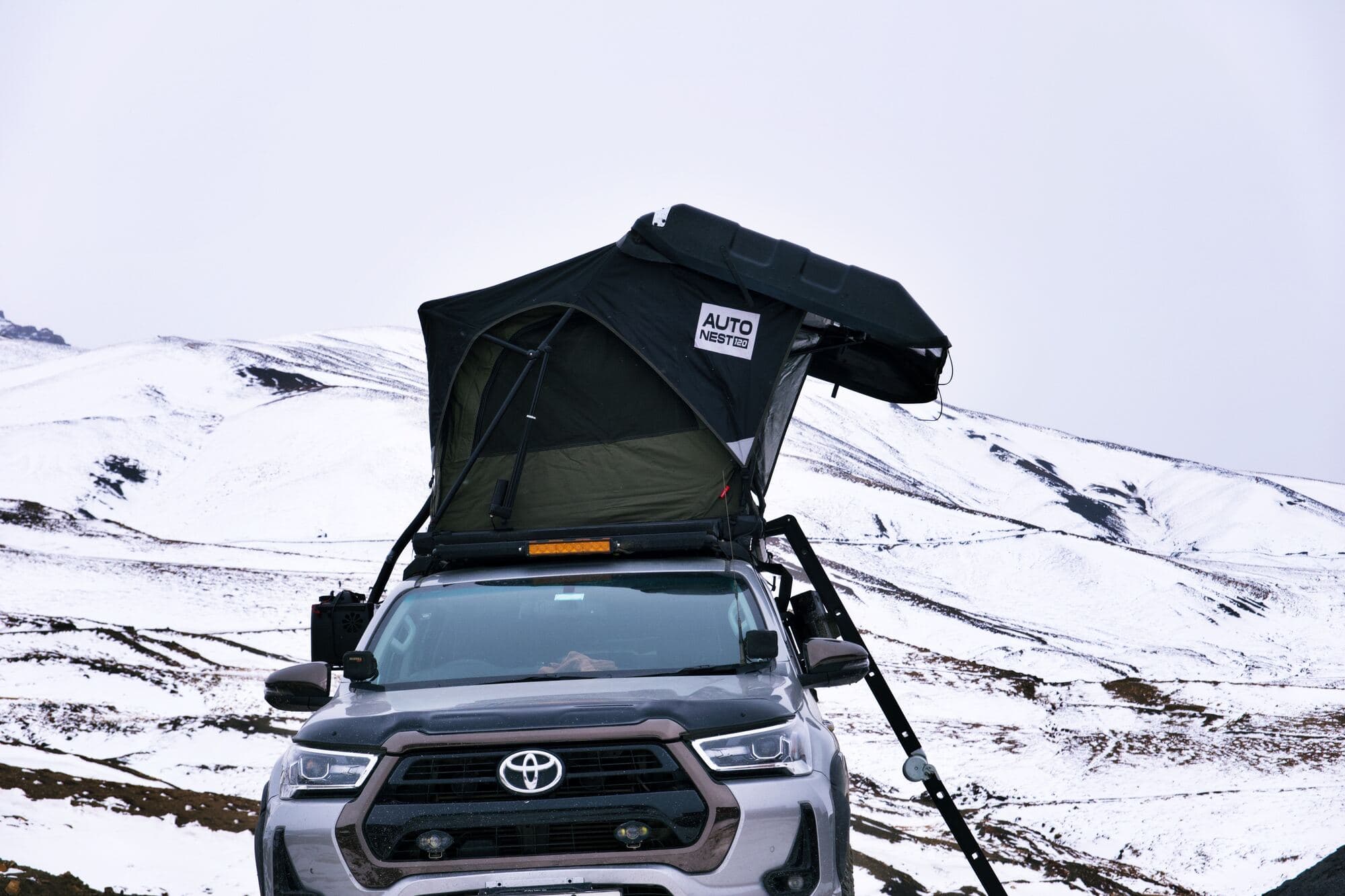
The FeatherLite is a softshell, and proudly so. Its fold-out design under a PVC travel cover is how we hit 36.5 kg while still giving two adults a genuine full-length, full-width bed - it opens to 236 x 125 x 113 cm and packs down to a low 118 x 125 x 29 cm closed profile that keeps wind noise down and lets the Jimny keep driving like itself. The structure is reinforced full aluminium, not flimsy tube, so it resists flexing in strong gusts and is rated to stay planted in Grade-7 wind conditions. Light does not have to mean fragile - the whole point of the FeatherLite was to prove that.
- Softshell wins on weight: it skips the 25-35 kg rigid lid that a Jimny roof cannot carry dynamically.
- Full-size platform anyway: the FeatherLite opens to 236 x 125 x 113 cm - two adults get a genuine full-length, full-width bed.
- Low closed profile: packs to 118 x 125 x 29 cm, so wind noise stays down and the small rig drives normally.
- Not fragile: reinforced full aluminium structure rated for Grade-7 wind, with an aerodynamic shell to cut drag.
Why the FeatherLite Is Built for the Jimny Specifically
We did not shrink a big tent and call it light. The FeatherLite exists because the Suzuki Jimny owners who kept calling us deserved a real answer, so we treated weight as the design brief from the first sketch rather than an afterthought. The result is one of the world's lightest premium rooftop tents - 36.5 kg for the tent and 6 kg for the telescopic aluminium ladder - light enough to mount on a Jimny without compromising handling, and light enough for one person to manage at the end of a long driving day. The Jimny is listed in the FeatherLite's vehicle compatibility, alongside compact and family SUVs like the Thar, Scorpio-N, Fortuner, Endeavour and Safari, so you are not guessing whether it belongs on your rig.
There is a second reason it suits the Jimny in particular: it is modular and self-serviceable. Every part is detachable and replaceable and can be swapped individually, with no complicated factory returns. That matters more on a small expedition rig than on a garage queen - if something needs attention three days into a remote loop, you fix it yourself rather than abandoning the trip. Inside, a high-density thermal-controlling mattress and smart ventilation give you a comfortable, condensation-managed night, while the ultra-light build keeps strain off the Jimny's modest suspension and helps fuel economy on the long tarmac transits that bookend every Himalayan trip.
- Engineered light from the start: 36.5 kg tent plus a 6 kg telescopic aluminium ladder - one person can manage it.
- Jimny is on the official compatibility list, alongside Thar, Scorpio-N, Fortuner, Endeavour and Safari.
- Modular and self-serviceable: every part detachable and replaceable, so you can fix it on the trail, not at a service centre.
- Comfort built in: high-density thermal-controlling mattress and smart ventilation for airflow and condensation control.
Crossbars and Mounting: The Make-or-Break Detail on a Small Roof
A rooftop tent is only as safe as what holds it down, and on a Jimny the mounting platform deserves extra respect because there is so little roof to work with. You need properly rated crossbars - not a decorative roof rail and not a basket. The bars carry the entire tent and its dynamic load, and their own weight counts inside your dynamic budget, so choose a light but strong set and count those kilograms honestly. Mount the FeatherLite to the bars using its supplied mount kit, keep the load centred and even across both bars, and confirm the right bar system for your exact Jimny variant before you order so the fit is right the first time.
Then comes the single most important habit for Indian roads: re-torque after washboard. The corrugated approaches into Spiti and Ladakh vibrate fasteners loose - that is physics, not a defect, and a short-wheelbase Jimny jolts over corrugations harder than a longer rig. After your first long washboard stretch, and periodically through a trip, stop and check every mounting bolt and bring it back to spec. Treat it exactly like checking tyre pressure: a routine, non-negotiable five-minute ritual. It is what stands between a tent that stays planted for a decade and one that develops play, rattles, and eventually a real problem on the worst track at the worst moment.
- Use rated crossbars, never a basket or factory rail alone - they carry the full tent and its dynamic load.
- Count the crossbar weight inside your dynamic budget, then mount the FeatherLite with its supplied mount kit, centred and even.
- Confirm the correct bar system for your specific Jimny variant before ordering - a tiny roof leaves no room for a wrong fit.
- Re-torque every mounting bolt after the first long washboard section and periodically through the trip - corrugations WILL loosen fasteners.
On a Jimny, every kilo on the roof counts double. We built the FeatherLite at 36.5 kg so you can have a real rooftop tent on the smallest serious 4x4 in India without ever overloading it.
Dinesh, Founder, AdventureX4x4
Where a Jimny Softshell Belongs - and Its Honest Cold-Weather Limit
A Jimny with a FeatherLite is a superb three-season micro-overlander. The 240 GSM PU-coated poly-cotton canvas handles rain and shoulder-season cold well, with an operating range of roughly -10C to +48C, which covers the overwhelming majority of Indian overlanding - a summer Spiti loop, a monsoon Western Ghats run, a Rann of Kutch winter camp, a post-monsoon Ladakh circuit. For those trips the FeatherLite is well within spec, and the Jimny's small footprint lets you tuck into camps and trails that a Fortuner simply cannot reach. This is the sweet spot, and it is a big one.
Now the honesty that marketplace sellers skip. A softshell is not a deep-winter, sub-zero expedition tool. When you are camping high in a frozen-Spiti February with the mercury at -20C or colder, a rigid hardshell with sub-zero insulation and a snow-shedding lid is the right answer - and that is a deliberate trade we make, because at those temperatures we would rather point you to the correct tool than oversell the light one. The good news is that on a Jimny built for cold routes, the rest of the kit matters more than the tent's season rating: fit the right snow chains and respect the ice. For a Jimny on the TractionX ladder that means the MX120, which is sized for the Gypsy, Jimny, Bolero and old Safari, and is a TUV GS and ONORM V5117-rated set using a heat-treated Boron-Titanium-Manganese-Chromium-Carbon alloy. Tent for the season, chains for the road - match both to the trip and the Jimny will take you a very long way.
- Three-season sweet spot: 240 GSM PU-coated canvas, ~-10C to +48C - covers summer Spiti, monsoon Ghats, Rann winter, post-monsoon Ladakh.
- Jimny advantage: the small footprint reaches camps and trails a full-size SUV cannot.
- Honest limit: a softshell is not a -20C deep-winter tool - for frozen Spiti in February choose a hardshell with sub-zero insulation.
- Cold-route kit: a Jimny on ice wants TractionX MX120 chains (TUV GS / ONORM V5117 rated, sized for Gypsy, Jimny, Bolero, old Safari).
How to Make the Final Call for Your Jimny
Do these three things in order and you will not buy the wrong tent. First, accept that the Jimny's low dynamic roof load rules out heavy hardshells and points you to a lightweight softshell - this is not a preference, it is the vehicle. Second, confirm a 36.5 kg tent plus your chosen rated crossbars sits comfortably inside a conservative dynamic budget, with the bar weight counted in. Third, match the tent to your season: the FeatherLite for three-season overlanding where the Jimny shines, and a hardshell for genuine deep-winter expeditions. Get those three in that order and your Jimny becomes the lightest, most go-anywhere rooftop-tent rig in the country - which is exactly what we built the FeatherLite to make possible.
Frequently Asked Questions
What is the best rooftop tent for a Suzuki Jimny?
For most Jimny owners it is the AdventureX4x4 FeatherLite, a lightweight fold-out softshell built specifically because heavier hardshells overload a compact 4x4's roof. At 36.5 kg for the tent (plus a 6 kg ladder) it is roughly half the weight of a typical hardshell, yet still opens to a full-size 236 x 125 x 113 cm sleeping platform for two adults. The Jimny is on its official compatibility list, so you are not guessing whether it belongs on your rig.
How much weight can a Jimny roof hold for a rooftop tent?
There are two numbers. Parked, the static load is high - often 150 to 200 kg or more - which is why a deployed tent safely sleeps two adults. Moving, the dynamic load on Indian factory roofs is typically only 50 to 75 kg, and on a small rig like the Jimny you plan to the low end of that band, with the crossbar weight counted in. Always size the tent's closed, ready-to-drive weight to that dynamic figure - a 36.5 kg FeatherLite leaves margin where a 65 kg hardshell does not.
Why is a lightweight softshell better than a hardshell for a Jimny?
Weight. A hardshell's rigid ABS or aluminium lid typically adds 25 to 35 kg over a comparable softshell, and that is exactly the weight a Jimny's roof cannot safely carry while driving. The FeatherLite's fold-out softshell design is how we deliver a genuine full-size bed at just 36.5 kg. A hardshell is the right call on a heavier vehicle that can take the load, and for deep-winter expeditions - but on a Jimny, light wins.
Do I need special crossbars for a rooftop tent on my Jimny?
Yes. You need properly rated crossbars, not a decorative rail or a basket, because the bars carry the entire tent and its dynamic load and their own weight counts inside your budget. Mount the FeatherLite with its supplied mount kit, keep the load centred and even across both bars, and confirm the correct bar system for your exact Jimny variant before buying. On a roof this small there is no room for a wrong fit.
Is the FeatherLite softshell weatherproof enough for the Himalayas?
For three-season Himalayan overlanding, yes. Its 240 GSM PU-coated canvas handles rain and shoulder-season cold well, with an operating range of about -10C to +48C, which covers most summer and post-monsoon Himalayan trips. For a genuine deep-winter, sub-zero expedition - think frozen Spiti in February at -20C - we would point you to a hardshell with sub-zero insulation instead. Match the tent to the season honestly and it performs exactly as intended.
Can a Jimny with a rooftop tent handle a winter route with ice?
It can, but the tent is only part of the answer - on ice, the chains matter more. For three-season cold the FeatherLite is fine; for the icy sections of a winter circuit, fit the right snow chains and respect the ice. On the TractionX ladder a Jimny takes the MX120, which is sized for the Gypsy, Jimny, Bolero and old Safari and is a TUV GS and ONORM V5117-rated set with a heat-treated Boron-Titanium-Manganese-Chromium-Carbon alloy. Tent for the season, chains for the road, and re-torque the tent mounts after washboard.
Is the FeatherLite hard to set up or repair on a trip?
No on both counts. Setup is a quick fold-out: unclip the PVC travel cover, fold the tent out over the telescopic ladder, extend the ladder, and you are ready - packing down takes about the same. Repairs are deliberately owner-friendly: the FeatherLite is modular and self-serviceable, with every part detachable and replaceable and swappable individually, so if something needs attention three days into a remote loop you fix it yourself rather than ending the trip.
Ready to kit out?
Everything in this guide is built, stocked and backed by AdventureX4x4 — engineered for Indian cold and proven from Spiti to Ladakh.