Vehicle Builds
Building a 14-day overland Thar: every part, every bolt
The full bill of materials for our reference Mahindra Thar build - drivetrain, suspension, recovery, sleep, kitchen, power. Nothing hidden.
The Mahindra Thar is the most common overland platform in India for good reason - capable, supported everywhere, and affordable to build. This is the complete specification of our reference 14-day-capable Thar: the exact build we hand to customers who ask 'what do I actually need?' We have run this configuration, or close variants of it, on the Ladakh Loop and on summer Spiti, and it is deliberately boring in the best way - nothing on it is there to impress a car park, every part is there because two weeks off-grid demands it.
Philosophy: 14 days, self-sufficient
The build target is 14 days off-grid for two people without resupply beyond fuel. Every choice below serves that target. We do not add anything for looks, and we do not skip anything that 14-day autonomy actually requires.
Fourteen days self-sufficient is a specific engineering brief, not a vibe. It sets the water you carry, the power you need to keep a fridge cold, the food storage that keeps two weeks of supplies accessible without unpacking the whole vehicle every evening, and the recovery kit that has to get you unstuck without a second vehicle because there may not be one. It also sets what you leave off: anything that does not serve the fourteen-day target is weight you carry up every pass for nothing. Both the current diesel and petrol Thar work as a base; the diesel's range and low-down torque make it our default for long remote runs, but the build below adapts to either.
Suspension and drivetrain
- Mild 2-inch lift - enough for clearance, not so much it ruins on-road manners
- All-terrain tyres sized to clear the lift without rubbing
- Recovery points front and rear - rated, bolted to the chassis, not the bumper
- Underbody protection: sump, transfer case, fuel tank
On tyre sizing, the honest sweet spot for a mildly lifted Thar is a 255/75 R16 all-terrain. It clears a 2-inch lift without rubbing at full lock, adds useful sidewall for airing down, and keeps the speedo error and the load on the modest engine sensible - go much taller and you are re-gearing and fighting the powertrain for no real-world gain. Air-down discipline matters more than tyre size anyway: we run roughly 18 psi for sand in the Rann, 22 to 26 psi for the icy packed snow above Kaza, and back to road pressure the moment we hit tarmac, which is what a quality deflator and compressor are for. The 2-inch lift is deliberately mild - enough to clear obstacles and fit the bigger rubber, not so much that you raise the centre of gravity and make a short-wheelbase vehicle nervous on a loaded mountain road. And the recovery points are the one place we refuse to compromise: rated, chassis-mounted points front and rear, never a bracket bolted to a cosmetic bumper that will tear off under a kinetic load.

Sleep
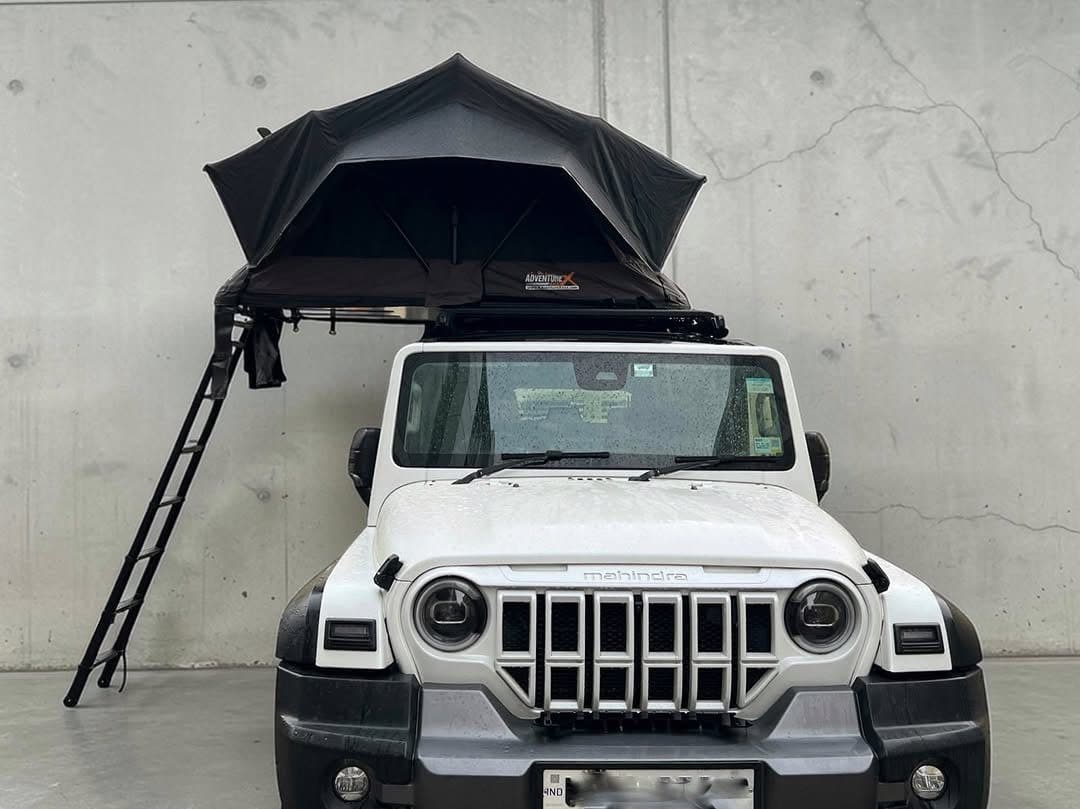
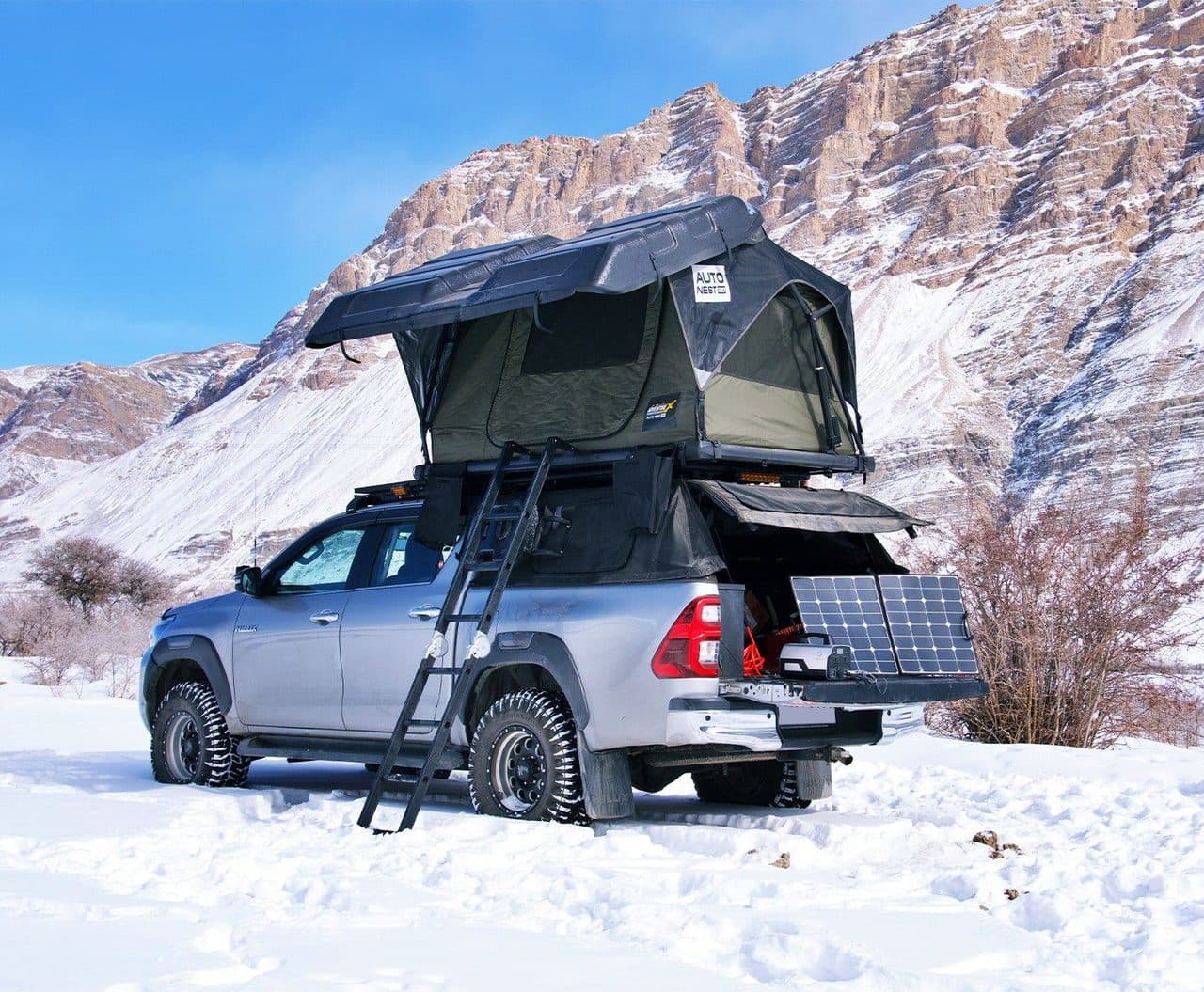
On a Thar we usually fit the Leopard 41 or the AutoNest 120, depending on budget. The Thar's roofline carries a rooftop tent well; we always confirm the cross-bar dynamic load rating before mounting anything.
The dynamic load rating is the number that actually matters and the one people skip. The roof can carry far less while you are moving over rough ground than it can while parked, because every pothole and washboard section multiplies the load through the rack - so the figure to check is the dynamic rating of the bars and mounts, not the headline static number on the box. A hardshell like the AutoNest 120 sits within a properly rated Thar setup comfortably, and its sub-one-minute deploy is worth real money on a long day into a high camp. We mount it as low as the rack allows and as far forward as the geometry permits, because every kilo up high on a short-wheelbase vehicle is felt in the way it leans through a rutted corner.
Recovery, water, power, kitchen
- Recovery: traction boards, kinetic rope, rated shackles, a quality deflator and compressor
- Water: a 26 L tank (HydroX26) mounted low for centre of gravity
- Power: a dual-battery setup or a portable power station sized to your fridge
- Kitchen: a slide-out drawer system keeps 14 days of food accessible without unpacking
Let me put real numbers behind those line items. Water: 26 litres is the floor for two people for a long leg, and on genuine two-week runs we add a second HydroX26 - the lesson a customer learned the hard way when a Ladakh trip came up short. Mount it low and central; water is heavy and you want that mass at the bottom of the vehicle, not up high. Power: a 50-litre compressor fridge pulls meaningful current across a hot day, so size the system to it. A portable power station in the 500-1000 Wh class run off a solar panel suits most two-person trips; if you live out of the vehicle for weeks at a stretch, a proper dual-battery install with a DC-DC charger off the alternator is the more robust answer. Recovery: traction boards plus a kinetic rope, rated shackles or soft shackles, a deflator and a compressor cover the overwhelming majority of real situations - sand in the Rann, snow above Kaza, mud in the Ghats. Kitchen: a slide-out drawer system is the single upgrade customers rave about most, because it is what lets you find day-nine dinner without unpacking day-one's gear onto the dirt.
A good overland build is not the one with the most accessories. It's the one where every accessory earns its weight.
A note on weight and payload
Here is the discipline that separates a build that drives well from one that wallows: track the payload. A Thar's usable payload is modest once you have two adults in it, and a rooftop tent, a full water load, a fridge, a power station, recovery kit and two weeks of food add up frighteningly fast. The failure mode is not dramatic - it is a vehicle that is slow up the passes, hard on the brakes coming down, harsh over washboard, and quicker to lean than it should be. So weigh the build, keep the heavy items low and central, and be ruthless about the marginal stuff. Every kilogram you leave off is a kilogram you do not haul over the Baralacha La and back. The best Thar builds we hand over are defined as much by the considered empty space in them as by what is bolted on.
Put rough numbers to it so the warning is real, not abstract. Two adults is already well over a hundred kilos. A hardshell rooftop tent is another fifty to sixty. Fifty-plus litres of water is fifty-plus kilos. A fridge, a power station, a full recovery kit, a drawer system, fuel in cans, and two weeks of food for two people can easily add another hundred and fifty. You are into several hundred kilograms of added load before you have packed a single bag of clothes, and a Thar's payload headroom does not absorb that casually. This is why we obsess about mounting the tent low and forward, the water low and central, and why we question every nice-to-have - because the alternative is a vehicle that drives like it is carrying a second vehicle, which over a fortnight in the mountains is exactly what it is.
Want this exact build?
We are building a vehicle configurator that will let you spec this Thar - and Jimny, Fortuner, and Defender builds - part by part, and add the whole thing to cart in one go. Until then, call the workshop and we will spec it with you.
Frequently Asked Questions
What tyre size is best for an overland Thar?
A 255/75 R16 all-terrain is the sweet spot for a mildly lifted Thar - it clears a 2-inch lift without rubbing, adds sidewall for airing down, and keeps the load on the engine and the speedo error sensible. Going taller forces a re-gear and fights the modest powertrain for little real-world benefit. The tyre matters less than the discipline of airing down: low teens of psi for sand, low-to-mid twenties for packed snow, full pressure on tarmac.
Petrol or diesel Thar for overlanding?
For long, remote, fuel-stretched runs we default to the diesel for its range and low-down torque, which is exactly what loaded mountain driving rewards. The petrol is a perfectly good base too, especially if your trips are shorter and fuel stops are frequent. Either way the build is the same - the engine choice changes your range planning, not your gear list.
Do I really need a dual-battery setup?
Only if you run a fridge across long days or stay out for weeks at a stretch. For most two-person trips a 500-1000 Wh portable power station with a solar panel keeps a fridge and devices going and is simpler to live with. Step up to a proper dual-battery install with a DC-DC charger when your autonomy target genuinely outgrows the power station - the fridge is almost always the deciding load.
Gear featured in this story
The kit named above, with current pricing - tap through for full specs.
Put it into practice
Building your own rig? Start with the kit that earns its place first.