

Gear Deep-Dive
Roof Racks, Crossbars and Roof Load Limits for the Thar, Jimny, Hilux and Fortuner
Your roof's dynamic limit, not the rack, decides what you can carry. Here are real numbers for the Thar, Jimny, Hilux and Fortuner.
The number that decides what you can carry on your roof is your vehicle's dynamic roof load limit - the safe weight while driving - and for most of these 4x4s it is far lower than people assume: roughly 50 kg dynamic for a Suzuki Jimny, around 75 to 100 kg for a Mahindra Thar depending on the rack and roof, and commonly 75 to 100 kg dynamic for a Toyota Hilux and Fortuner, with much higher static (parked) limits. A heavy hardshell rooftop tent plus gear can blow past these figures quickly, and the rack you bolt on does not raise the roof's own structural limit. So the rule is to know your dynamic limit first, subtract the rack's own weight, and only then choose your tent and load. Here is how it works for each vehicle and how to load safely, with worked examples for the rigs we kit out every week.
What is the difference between dynamic and static roof load?
Dynamic load is the maximum weight your roof can safely carry while the vehicle is moving, and static load is what it can hold when parked - and the static figure is dramatically higher, which is the source of endless confusion. Driving subjects the roof to cornering forces, braking, potholes and the leverage of a high centre of gravity, so manufacturers set a conservative dynamic limit, often around 50 to 100 kg on these vehicles. Parked, the roof can hold far more - which is why two adults sleeping in a rooftop tent (well over the dynamic limit combined) is fine: that load is static. What matters for choosing gear is the dynamic number, because your tent and rack must be safely within it while you drive to the campsite. Always design around dynamic, and treat the high static figure as relevant only once you are stopped. The forces multiply on exactly the roads you bought a 4x4 for: a corrugated Ladakh washboard or a Spiti water bar feeds the roof load repeated shock that a smooth highway never does, which is why the dynamic limit is conservative for good reason.

What are the real roof load limits for the Thar, Jimny, Hilux and Fortuner?
Use these as working figures and always confirm against your own owner's manual and rack maker, because exact numbers vary by model year, roof type and the specific rack. The Suzuki Jimny has a modest dynamic limit around 50 kg, so it demands the lightest possible setup. The Mahindra Thar typically supports roughly 75 to 100 kg dynamic with a suitable rack, enough for a light hardshell tent and minimal gear. The Toyota Hilux and Fortuner generally sit around 75 to 100 kg dynamic, giving more flexibility for a tent plus an awning. Crucially, the rack itself weighs something - often 15 to 30 kg - and that comes off your available payload before you add a single item. The static limits are far higher across all four, which is why people get away with sleeping up top.
- Suzuki Jimny: about 50 kg dynamic - lightest tent only, low-profile rack, careful loading.
- Mahindra Thar: roughly 75 to 100 kg dynamic with a suitable rack - light hardshell tent plus minimal gear.
- Toyota Hilux: commonly 75 to 100 kg dynamic - tent plus awning feasible, and a bed rack is an even better answer.
- Toyota Fortuner: commonly 75 to 100 kg dynamic - similar flexibility to the Hilux.
- Subtract the rack's own 15 to 30 kg from your dynamic limit before adding any gear.
Worked examples: doing the maths for each rig
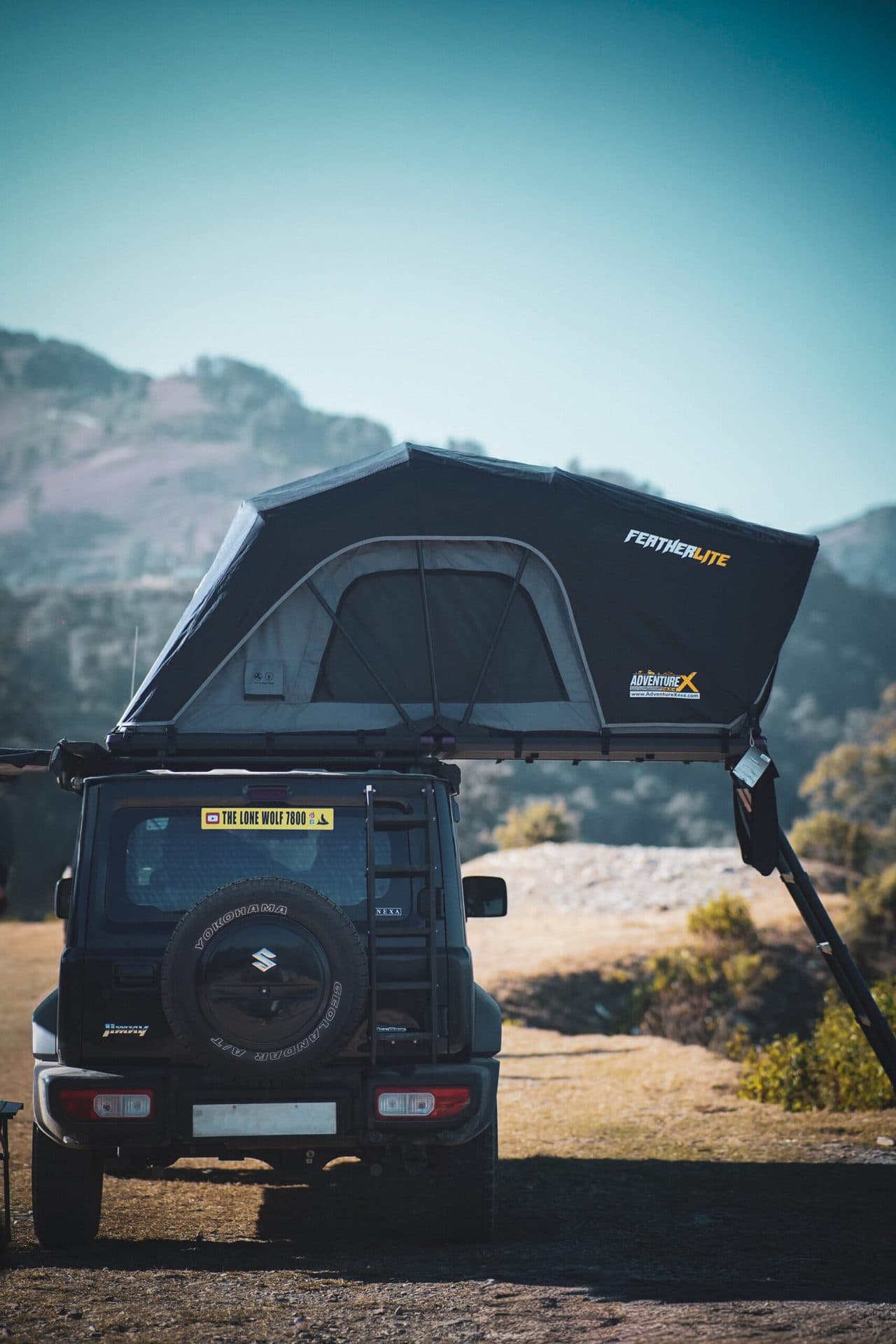
Numbers in the abstract are easy to ignore, so let us spend the budget for real. Take a Jimny with a 50 kg dynamic limit. Fit a low-profile rack at 18 kg and you have 32 kg left. A genuinely light hardshell tent that weighs around 45 to 50 kg already blows the budget on its own - which is why on a Jimny the honest answer is usually a ground tent or a CampTop-style setup off the side, not a heavy shell on top. Now take a Thar at 90 kg dynamic. A 25 kg rack leaves 65 kg, which comfortably carries a light hardshell like the FeatherLite plus a couple of soft bags, but does not leave room for a tent and a loaded roof box and four jerry cans - pick. On a Hilux at 90 kg dynamic, the smartest move sidesteps the roof entirely: mount the tent on a bed rack over the load bed so the roof figure stops being the constraint, which is exactly how our fully-kitted Hilux builds carry an expedition hardshell without drama.

Does a stronger roof rack raise my load limit?
No - and this is the most expensive misconception in the hobby. A heavy-duty rack does not increase your roof's structural capacity; the limit is set by the vehicle's roof and mounting points, not by how beefy the rack is. Bolting on a massive platform rack rated to carry 300 kg does not mean your Thar's roof can carry 300 kg while driving - it cannot, and overloading it risks deforming the roof, cracking mounting points, dangerously raising your centre of gravity and making the vehicle unstable in corners and emergency manoeuvres. The rack must be strong enough not to fail itself, but your loading ceiling is always the vehicle's dynamic roof limit. A heavier rack is actually worse in one sense: its own weight eats into the limited payload you have. Choose a rack strong enough for the job but no heavier than necessary.

How does roof weight affect handling and rollover risk?
Every kilogram on the roof sits high above the vehicle's centre of gravity, so roof weight has an outsized effect on stability - far more than the same weight in the boot - making the vehicle lean more in corners, feel top-heavy, and become more prone to rollover on off-camber trails. A tall 4x4 like a Thar or Fortuner already has a high centre of gravity, and a loaded rooftop tent raises it further. The practical consequences: slow down for corners and on side-slopes, brake earlier, avoid sudden swerves, and be especially cautious on off-camber tracks where the lean from a heavy roof can tip you. This is also why keeping heavy items low and in the vehicle, and reserving the roof for lighter, bulky gear, is the smart loading strategy whenever you have the choice. On a single-lane shelf road above the Spiti river, where one set of wheels is always closer to the drop than you would like, a top-heavy rig that wants to lean is the last thing you want under you.
We see people put the heaviest things they own on the roof because it is the easy space, and then wonder why the truck feels nervous in corners. Keep weight low and inside wherever you can; the roof is for light and bulky, not heavy and dense. Your dynamic limit and your centre of gravity are what keep you upright on a mountain track.
What belongs on the roof, and what does not
Once you accept the dynamic limit, loading becomes a sorting exercise. The roof is for light, bulky, infrequently-needed items; the cabin and the floor are for heavy, dense items and anything you reach for often. Put the wrong things up high and you spend a hard mountain leg fighting a rig that leans and floats; put the right things up high and the roof earns its keep without hurting you.
- Good on the roof: the rooftop tent, a SaberLight 270 awning, sleeping bags and bedding, an empty roof box, light camp chairs and tables.
- Bad on the roof: water (1 litre is 1 kg, so 40 litres is 40 kg up high), the fridge, recovery gear, tools, full jerry cans, anything dense.
- Keep water, fridge and recovery kit low and centred between the axles inside the vehicle where they barely affect handling.
- Reserve roof space for the awning and bedding rather than dense supplies, and your loaded rig will corner and brake like itself, not like a top-heavy stranger.
How should you choose and load a rack the right way?
Match the crossbars or platform to your vehicle's mounting system, stay within the dynamic limit after subtracting the rack's weight, and distribute the load evenly and low-profile. Pick a rack designed for your specific vehicle's roof channels, rails or hard points rather than a universal clamp-on where avoidable, since a vehicle-specific mount spreads load correctly into the structure. Keep the rooftop tent and any heavy items centred over the strongest part of the roof, spread weight across the crossbars rather than concentrating it, and choose the lowest-profile setup that does the job to limit both wind drag and centre-of-gravity rise. Finally, recheck all fasteners after the first drive and periodically thereafter, because vibration loosens mounts and a shifting load on the roof is dangerous.
- Choose a rack matched to your vehicle's specific mounting points, not a generic clamp-on.
- Calculate available load as dynamic limit minus the rack's own weight.
- Centre heavy items over the strongest part of the roof and spread load across the bars.
- Pick the lowest-profile setup that works to limit drag and centre-of-gravity rise.
- Recheck all fasteners after the first drive and periodically on long trips - a Ladakh washboard road will find any bolt you left loose.
Frequently Asked Questions
Can I put a rooftop tent on a Suzuki Jimny?
Yes, but only the lightest hardshell tents and with careful attention to the Jimny's low dynamic roof limit of around 50 kg. After subtracting the rack's weight you have little headroom, so a heavy softshell is not advisable. Use a low-profile rack, keep additional roof gear to a minimum, and drive gently on off-camber terrain because the Jimny's short wheelbase and raised load make it sensitive to a high centre of gravity. For many Jimny owners a ground tent or an off-the-side setup is the more honest choice.
Why is the static roof limit so much higher than the dynamic one?
Because a parked roof only deals with steady downward weight, while a moving roof faces cornering forces, braking loads, impacts from potholes and the leverage of a high centre of gravity. Manufacturers therefore set a conservative dynamic limit for driving and a much higher static limit for parked loads. This is exactly why two people can sleep in a rooftop tent that weighs more than the dynamic limit - that combined weight is a static, parked load.
Does a heavy-duty rack let me carry more weight?
No. A stronger rack only ensures the rack itself will not fail; it does not raise your vehicle's roof structural limit, which is fixed by the roof and its mounting points. Loading beyond the dynamic limit risks roof and mount damage and dangerous instability regardless of how strong the rack is. Worse, a heavier rack consumes more of your limited payload, so choose one strong enough but no heavier than needed.
How much does roof weight affect my vehicle's stability?
Significantly, because roof weight sits high above the centre of gravity and has far more effect on lean and rollover risk than the same weight carried low in the vehicle. A loaded rooftop tent makes a tall 4x4 noticeably more top-heavy. Compensate by slowing for corners and side-slopes, braking earlier, avoiding sudden swerves, and keeping your heaviest gear low and inside the vehicle wherever possible rather than on the roof.
Gear featured in this story
The kit named above, with current pricing - tap through for full specs.
Put it into practice
Ready to kit out? Shop the gear we put through its paces here.